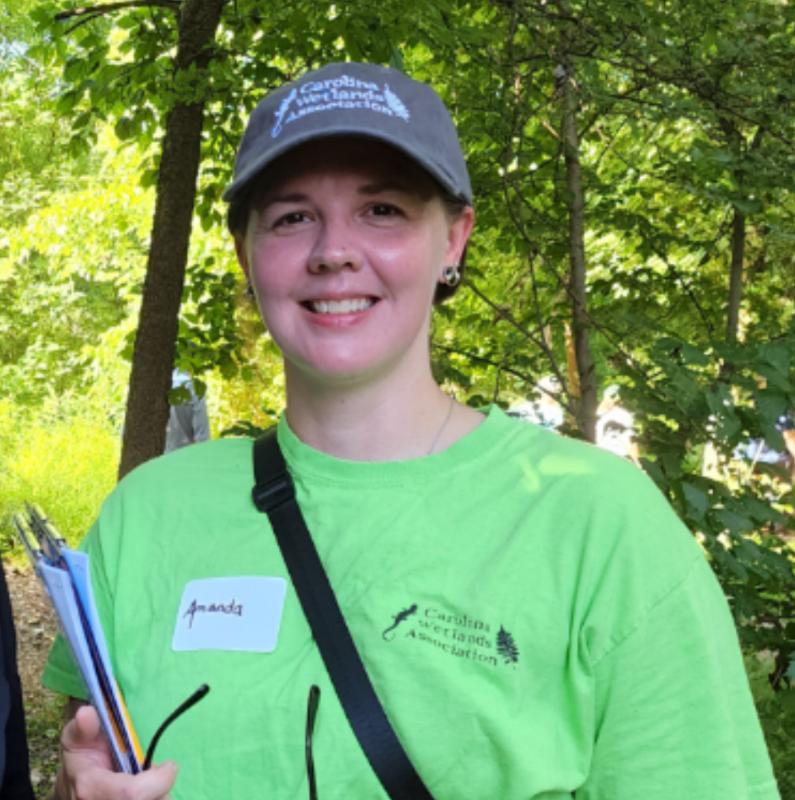
MEET VWMP PRINCIPAL INVESTIGATOR AMANDA JOHNSON

chase.bergeson • March 22, 2023

This is the second in an interview series of the principal investigators of the Volunteer Wetland Monitoring Program. If you missed it, read our last post about Thomas Reed.


Amanda Johnson


Senior Environmental Scientist at Timmons Group


Project Coordinator


Where did you grow up and if not the Raleigh/Durham area, what brought you here? 

I grew up in central Florida and moved to Waynesville, North Carolina when I was in middle school. I went to college at the University of North Carolina Wilmington (UNCW). I moved to Raleigh for graduate school and really enjoyed the Piedmont. I moved back to Wilmington after school but decided to come back to Raleigh to be closer to my family and for better job opportunities.


Where did you go to school and what led you to your career? 

I received a Master of Natural Resources degree from North Carolina State University (NCSU). While earning my degree, I had an internship and then eventually a seasonal position with the North Carolina Division of Water Quality (now Division of Water Resources) where I learned about wetlands, streams, and wetland mitigation sites. I decided I wanted a career where I can work in the field, so I pursued a job as an environmental consultant.


Could you tell us about your job at Timmons Group? 

I work as a Senior Environmental Scientist at Timmons Group where most of my work is focused on wetland and stream delineations and functional assessments, protected species habitat surveys, and Clean Water Act Section 401/404 permitting.


What sparked your interest in your area of expertise?

As a child, I loved playing outside and thought I wanted to be a zookeeper. While I was in high school, I had a science teacher that inspired me to study environmental science. He encouraged me to apply for a summer internship with the National Park Service, which I got. We studied salamanders, snakes, Vesper Sparrows, moths, planthoppers, and ozone effects on plants. I was hooked on environmental science. During my senior year at UNCW, I learned about wetland restoration and thought it was fascinating, so I decided to study restoration ecology at NCSU. My internship during graduate school gave me fieldwork experience, which set me up for my first job as an environmental consultant at a small firm in Wilmington.


What do you enjoy most about your role in the VWMP? What is your favorite memory so far working in the wetlands with the VWMP volunteers? 

I have really enjoyed establishing protocols for data collection and exploring the capabilities of different platforms, such as Wildnote and iNaturalist, to record our data. We have worked so hard to get the VWMP going, so it is wonderful seeing our volunteers in the field asking questions, collecting data, and having a good time. It was no surprise that our volunteers loved our amphibian surveys, but I must say, I was amazed at how much our volunteers were interested in learning about soils and getting their hands dirty at our sampling event in December 2022. I am looking forward to our next sampling events in 2023!
You might also like

Celebrating Our Carolina Wetlands

By kim.matthews • October 7, 2026
On September 9, 2026, the U.S. Environmental Protection Agency (EPA) and the U.S. Army Corps of Engineers issued a supplemental notice of proposed rulemaking (SNPRM) offering additional ways to define “waters of the United States” (WOTUS). Why this definition matters The WOTUS definition determines which water bodies the federal government can protect under the Clean Water Act. In November 2025, the agencies proposed revisions to bring the definition in line with the Supreme Court’s 2023 decision in Sackett v. EPA. After taking public comments, they have now put forward further options. The new proposal narrows federal jurisdiction even more, potentially stripping protections from the vast majority of U.S. wetlands and seasonal streams. What our comment letter says The Carolina Wetlands Association is submitting comments opposing the proposal. Our main concerns: It would undermine the Clean Water Act’s purpose. The law’s goal is to restore and maintain the chemical, physical, and biological integrity of the nation’s waters. This proposal would severely undercut that goal. The “days of water” test is a poor measure. The proposal decides jurisdiction by how many days a year water is present. That number correlates poorly with a waterway’s ability to carry pollution downstream to the rivers, lakes, and estuaries that would stay protected. Streams dry for as few as 30 days a year could lose protection, and polluters would have an incentive to discharge into them rather than into protected waters. Drinking water is at risk. About 56% of North Carolina’s stream miles feeding public drinking water systems are intermittent, ephemeral, or headwater streams. In South Carolina the figure is 51%. These systems serve 6.6 million people, who would bear higher health risks and treatment costs. Wetlands do critical work. They filter pollutants and nutrients that cause algal blooms, dead zones, and fish kills. Losing that function would also degrade groundwater, which many people drink untreated. The legal reasoning is flawed. We argue the agencies misread the Supreme Court’s language. “Relatively permanent” describes geographic features such as streams with defined beds and banks. The word “continuously” modifies “flowing” and doesn’t limit what counts as relatively permanent. It would be hard to implement. Many affected streams have no data showing how many days they lack surface water. That makes the rule difficult for agencies to administer and leaves landowners unable to tell whether the Clean Water Act applies to their property. The impacts haven’t been analyzed. The agencies should not finalize a rule before measuring the added pollution flowing from newly unprotected waters into those that supply drinking water, or projecting the resulting damage to downstream uses. What you can do Read the SNPRM Submit your comment by October 9, 2026, under Docket ID No. EPA–HQ–OW-2025-0322 . Personal stories about the streams, wetlands, and drinking water you depend on are especially effective. Learn more: read the comments we submitted on the November 2025 version of the rule, many of which still apply.
By kim.matthews • September 2, 2026
Welcoming New Members to the Carolina Wetlands Association Board
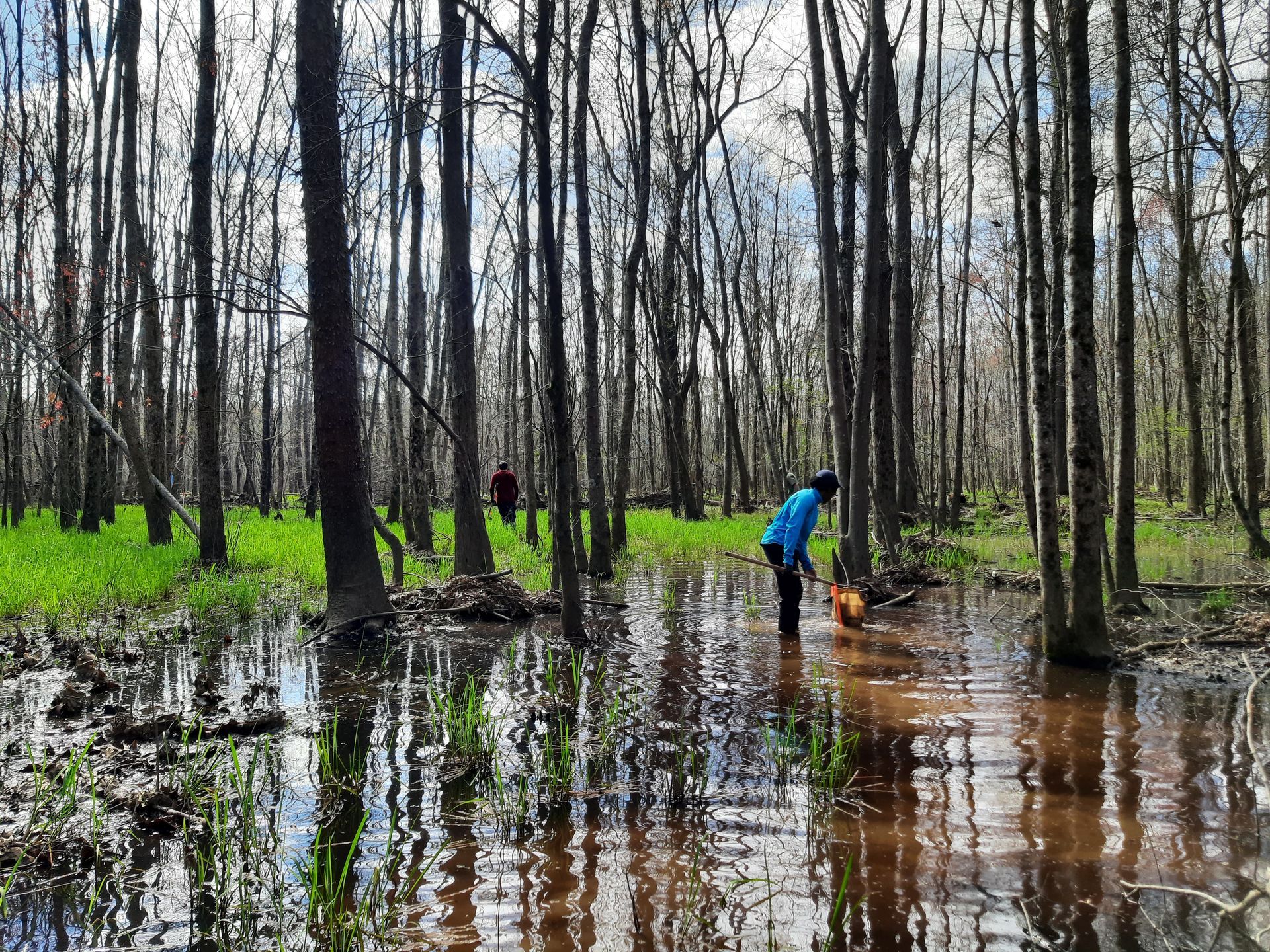
Forested wetland with surface water present
By rick.savage • August 3, 2026
North and South Carolina is starting to recover from one of the most severe droughts in recent history. Drought covered essentially both states with reservoirs like Falls Lake and Jordan Lake dropping well below normal and cities including Raleigh and Durham enacting mandatory water restrictions. While the drought is largely over (given the second wettest July on record), I still think it is important to understand how wetlands mitigate droughts because the bottom line is drought impacts would be a lot worse without wetlands.